


The complete guide
How to Choose a Kids Play Tent That Actually Gets Used
The problem with most play tents
Walk into a lot of homes with young children and you will find a play tent somewhere, usually behind a door or shoved under a bed. It was exciting for a fortnight. Then a pole bent, or the roof sagged, or it was simply too much hassle to put back up after it got knocked over, and it quietly stopped being part of the day.
That is not a failure of the child's imagination. It is almost always a failure of the product. Play tents get abandoned for three predictable reasons: they are fiddly to set up, they do not hold their shape, and there is nothing inside them to do once the novelty of crawling in wears off.
Knowing that makes choosing much easier. You are not really shopping for a tent. You are shopping for something that will still be standing in six months.
Why children want a small space in the first place
There is a reason children build dens out of sofa cushions without being asked. A big open room gives them no edges. A small enclosed space does, and that turns out to be calming.
For a child aged three to seven, a hideaway serves several jobs at once. It is somewhere to go when the house feels loud. It is a stage for pretend play, where the soft toys can be arranged and lectured. It is a reading spot that feels more interesting than a chair. And for a child who shares a bedroom, it may be the only square metre of the house that is theirs alone.
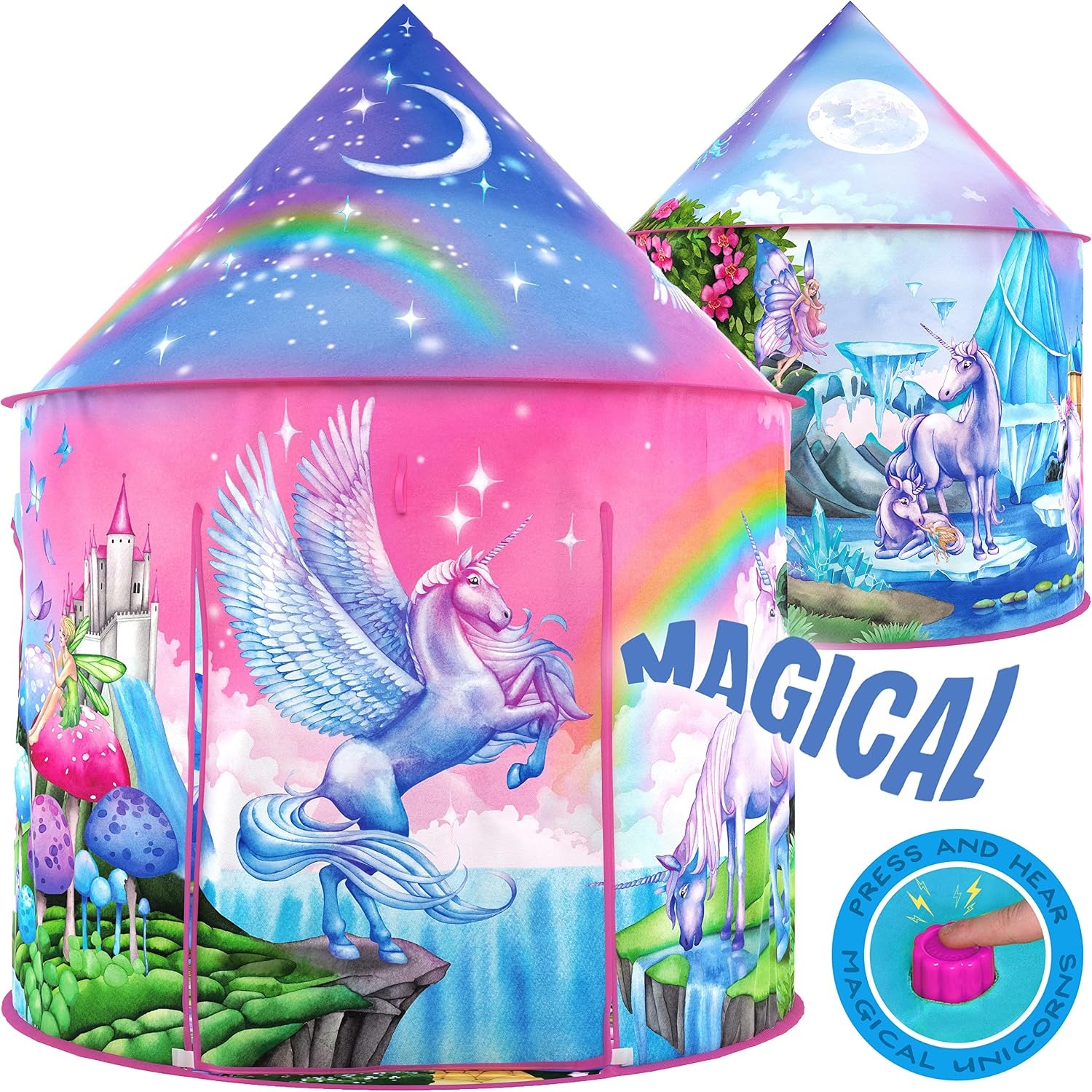
The Unicorn Sparkle Play Tent gives you about 101.6 cm square of floor and 129.5 cm of height. That is deliberately cosy. Two children fit comfortably, three if they do not mind elbows. Bigger is not better here, because a tent that feels like a room stops feeling like a secret.
How the construction affects how long it lasts
The single biggest difference between a play tent that survives and one that does not comes down to the poles.
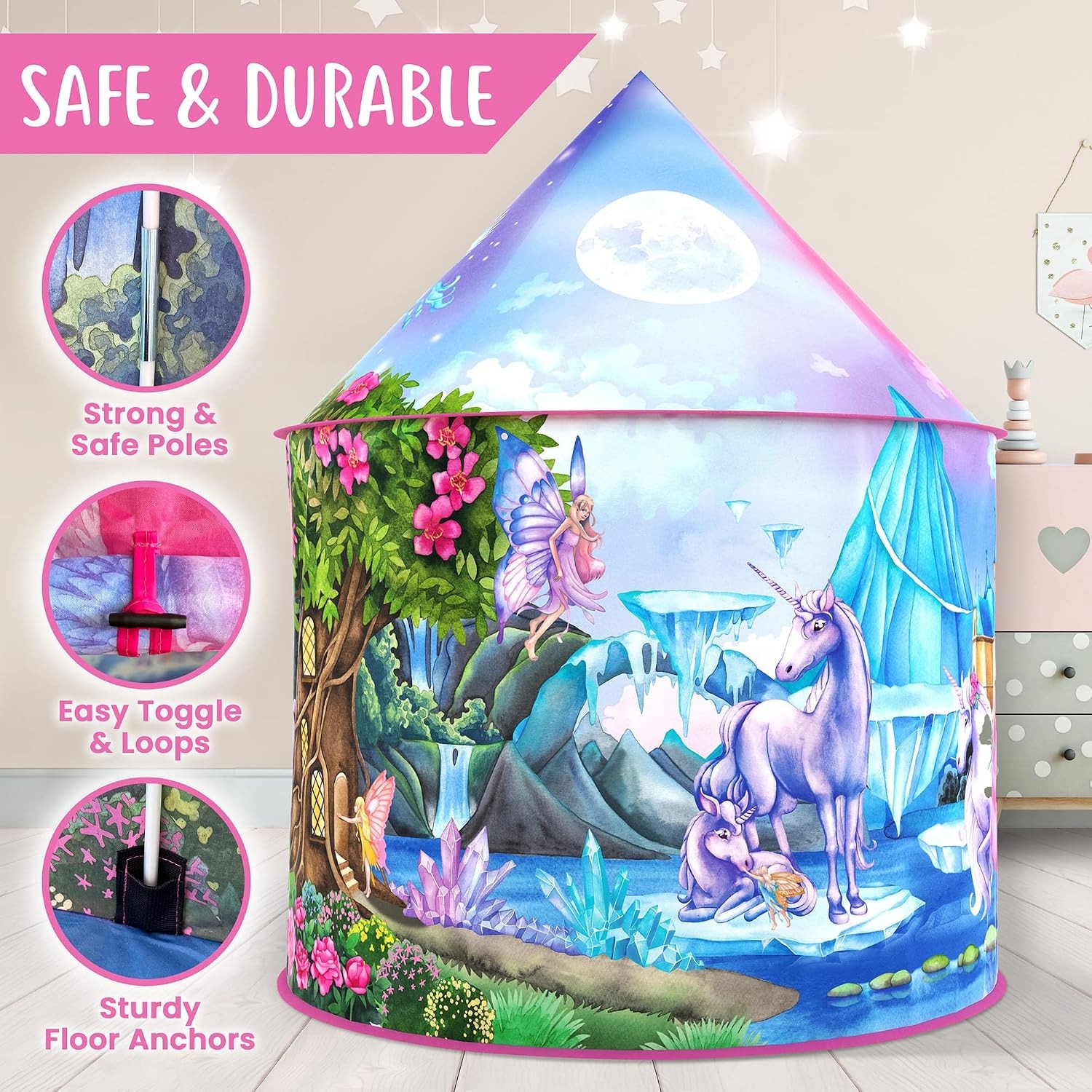
This tent uses fibreglass. Fibreglass flexes under pressure and springs back. When a child trips over a corner, or leans hard on a wall, or drags the whole thing across the carpet, the pole bends and recovers. Cheaper rods tend to take a set, meaning they stay slightly bent, and once that happens the tent never quite stands straight again. A leaning tent looks broken to a child, and broken toys get ignored.
The second thing to look at is where the poles meet the fabric. On this tent, the roof and floor pockets are reinforced, and the seams are double stitched. Those pockets take the full load every single time the tent is put up and taken down. If they tear, the structure is finished, and no amount of care with the rest of the fabric saves it. Reinforcement there is a sign the manufacturer understood where the failure point actually is.
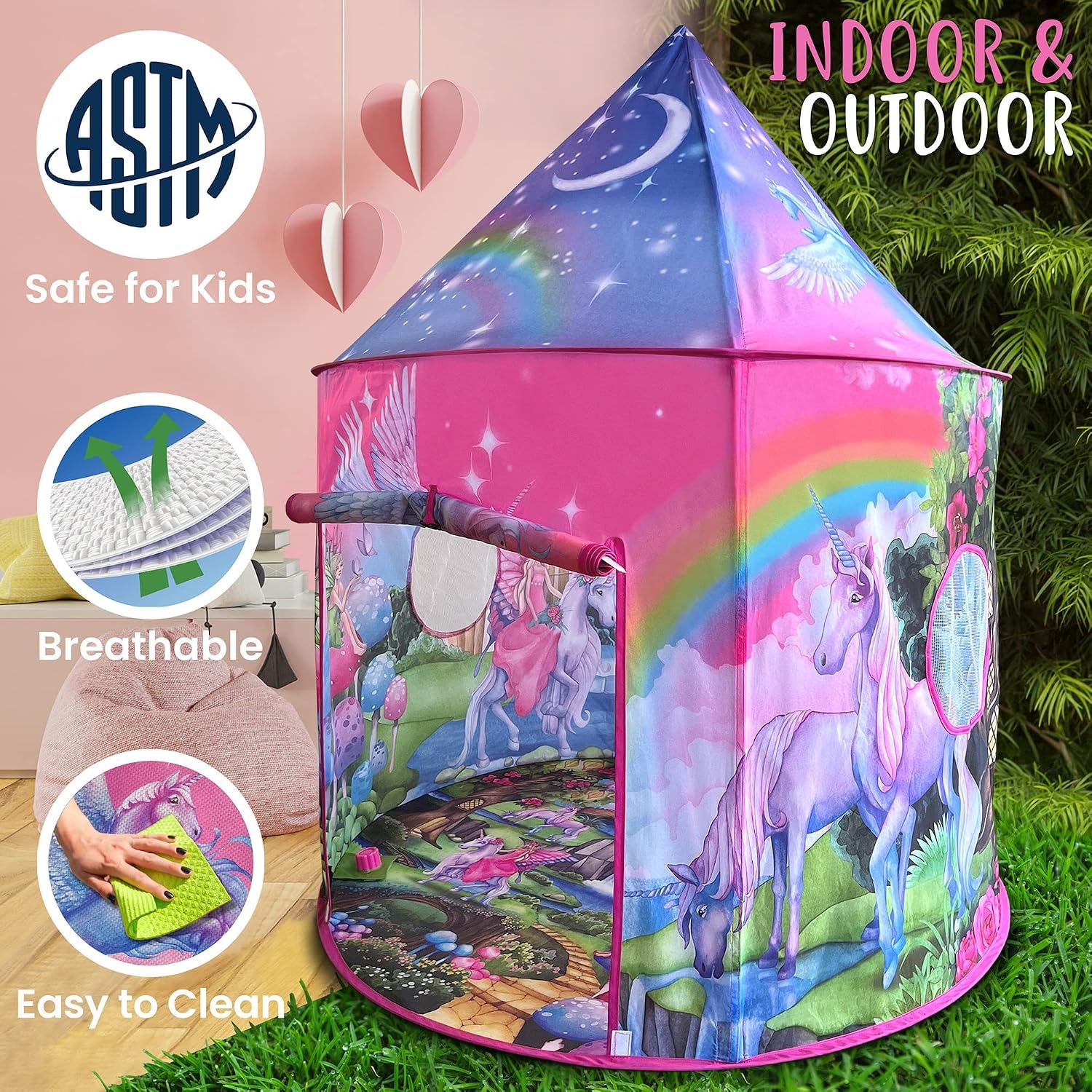
The canopy itself is polyester. That matters for practical reasons more than strength. Polyester wipes clean, which you will care about the first time a juice cup goes over or someone brings felt-tip pens inside.
The sound panel and why it helps
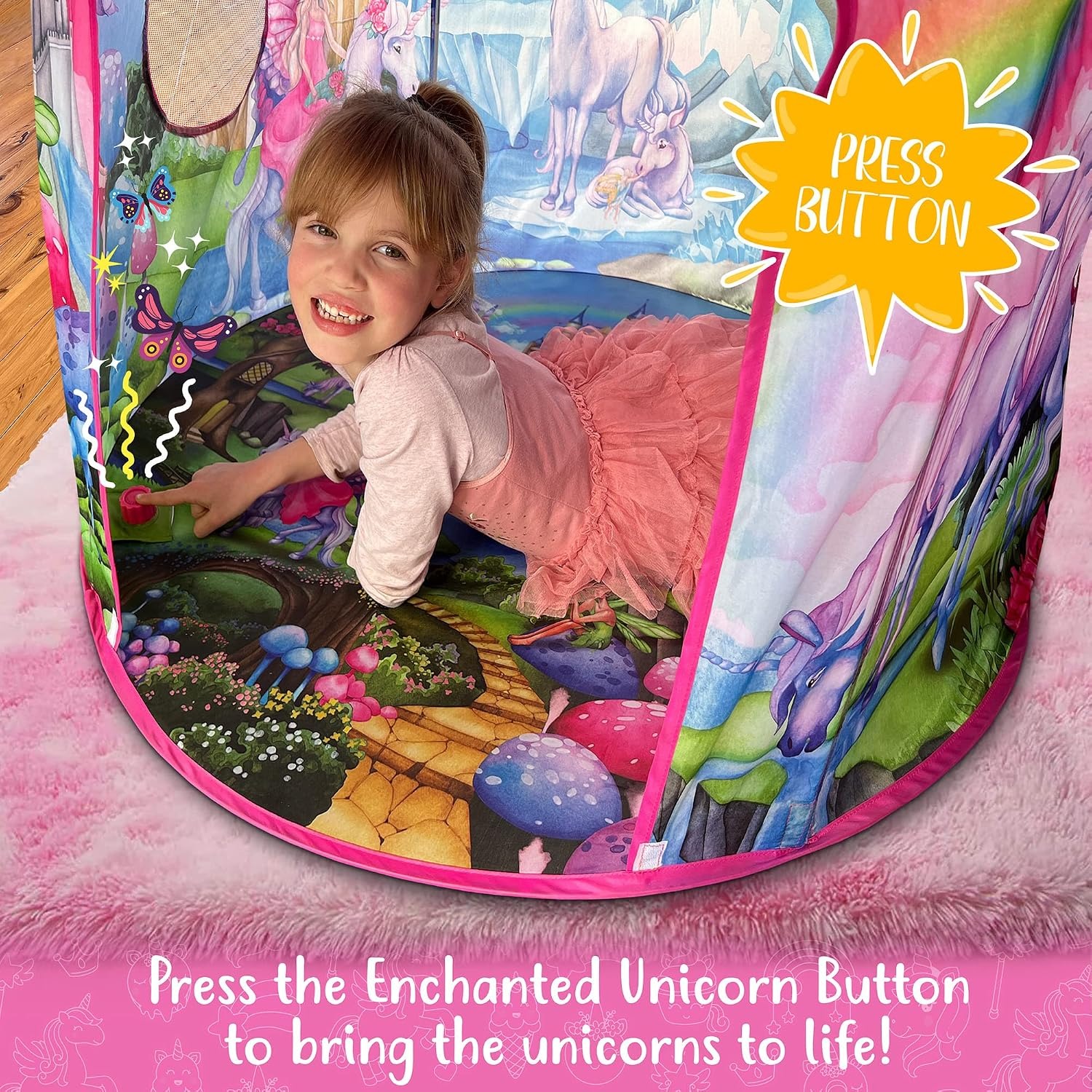
There is a button on this tent that plays six unicorn sound effects, powered by three LR44 batteries that come in the box.
It is easy to dismiss that as a gimmick. In practice, small children use sounds as story cues. The button becomes the moment the unicorn arrives, or the signal that the journey has started, or the thing you press to announce that your friend may now enter. It gives pretend play a structure it did not have before, and it does it without a screen.
It also helps with the novelty problem. A plain fabric cube is interesting for a while. Something that responds when you touch it stays interesting longer, especially for a three or four year old who is still delighted by cause and effect.
Because it only plays when pressed, there is no background noise to live with. If you ever want it fully silent, taking the batteries out leaves the tent working perfectly well as a playhouse.
Who this suits, and who it does not
The recommended age is 36 months to 7 years, and that range is honest. Below three, the size and the theme are not a good match, and the age guidance should be respected. Above seven, most children want something bigger or have moved on from a hideaway entirely.
Within that window, it works well for a few specific situations. It suits a family in a flat or a smaller house, because at 476 g and folding into a carry bag, it can disappear into a cupboard at the end of the day. It suits a shared bedroom, where one child needs their own corner. It suits a child who finds busy rooms overwhelming and benefits from a quiet retreat. And it suits anyone looking for the best unicorn play tent as a birthday or Christmas present, because it arrives as one complete item that works straight away.
It is not the right choice if you want something permanent and structural. A wooden playhouse frame does a different job. It is also not an outdoor shelter. It will happily sit on a dry lawn for an afternoon, but it has no waterproof rating in its specification and should come in before the weather turns.
Setting it up and keeping it going
Assembly takes minutes. The fibreglass poles slide into their channels, the ends seat into the corner pockets, and the tent holds its own shape. No tools, no screws, no diagram you need to study.
Pack-down is the reverse. The poles come out, the canopy folds flat, and the whole thing goes into the bag. This is worth practising once yourself before you hand it over, so you can show a five year old how to do it. Children who can put their own tent away tend to get it out more often.
For cleaning, a damp cloth with a little mild soap handles most marks. Let the fabric dry fully in the air before folding, because polyester packed away damp will smell. Keep water away from the sound panel. Nothing goes in a washing machine or a tumble dryer, and the fabric should not be ironed or bleached.
For storage, dry is the only rule that really matters. A hall cupboard is fine. A damp garage or a shed in winter is not. If the tent is being put away for a season, pull the LR44 batteries out so they cannot leak into the panel.
A few small things that make a difference
Put something soft on the floor. The tent has a fabric base, but a folded blanket or a small cushion changes it from a space you crawl into to a space you want to stay in.
Give it a job. A book basket, a flashlight, or a handful of soft toys inside means there is a reason to go in beyond the first five minutes.
Let them decide where it goes. A child who chose the spot takes more ownership of it. Even if the spot is slightly annoying, it is worth going along with.
And resist the urge to leave it up permanently. Counterintuitively, a tent that appears and disappears tends to stay exciting longer than one that becomes furniture.
The short version
The Unicorn Sparkle Play Tent is a fibreglass-framed polyester playhouse, about a metre square and 129.5 cm tall, with reinforced roof and floor pockets, double stitching, a six-sound unicorn button running on included LR44 batteries, and a carry bag.
What you are buying is a small private room your child can put up in minutes and pack away in the same. The fibreglass frame is the reason it should still be standing straight next year, and the sound button is the reason they should still be interested in it. If you want the best indoor play tent for a three to seven year old in a home where space is tight, this one covers the bases without taking over a room.